Builder
Can they actually build it?Real depth somewhere across full stack, data, DevOps, SRE, and AI—with working fluency across the rest.
THE ROLE FDE / FIELD GUIDE
A Forward Deployed Engineer is an engineer who works close to the customer, translates an ambiguous business problem into a production system, and remains accountable for whether that system creates a measurable outcome.
THE SIMPLE DEFINITION
They embed with users, learn the operating reality, choose what should change, build on the existing stack, and drive the system through adoption. The job is not complete when the demo works. It is complete when the workflow works.
For engineers, it is a career for people who want technical depth and customer responsibility. For companies, it is a way to give one capable owner the space between strategy, product, engineering, and the field.
THE FDE STANDARD
“Can you build the system, explain the decision to an engineer, explain the outcome to a VP, and stay accountable when the happy path breaks?”
Real depth somewhere across full stack, data, DevOps, SRE, and AI—with working fluency across the rest.
Context extraction, workflow redesign, stakeholder alignment, and clear communication from engineers to executives.
Shipping, observability, exception handling, outcome measurement, and accountability when the happy path breaks.
Evidence matters more than tenure. Naming tools is not the same as showing judgment.
THE COMPLETE FDE SKILL STACK
The role works because both sides meet in one accountable operator. The technical layers make the system real; the human capabilities make it useful inside a business.
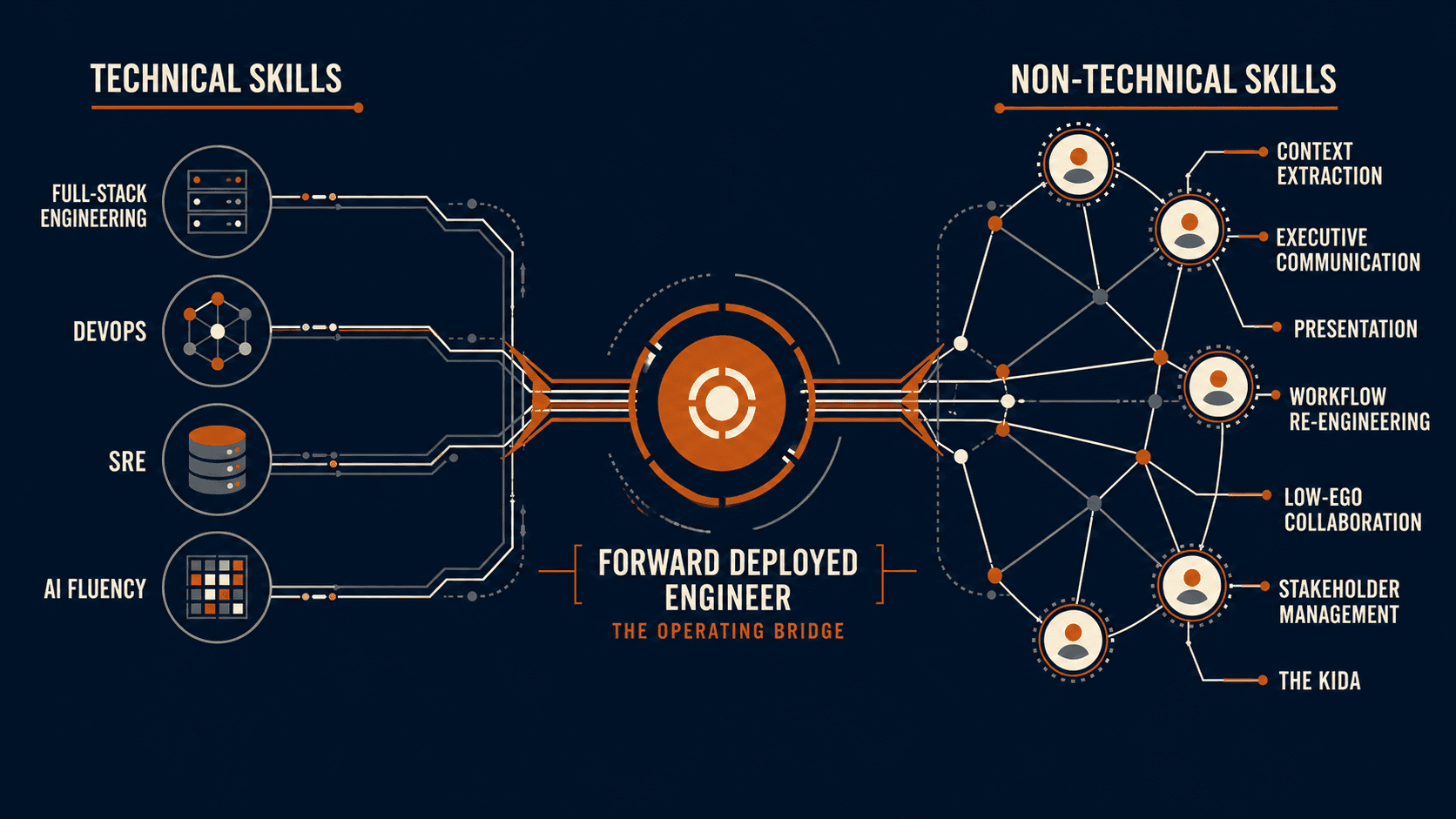
Front end, back end, databases, APIs, and the fluency to connect the system end to end.
CI/CD, cloud, infrastructure as code, and the release discipline required to move beyond a demo.
Unix, scripting, observability, incident response, and the ability to separate signal from noise.
Models, agents, guardrails, explainability, evaluation, routing, optimization, and production economics.
Find the real problem inside partial documentation, politics, and competing agendas.
Condense complexity into a conclusion, a next step, and the decision required.
Make the case in two useful slides rather than burying the decision in twenty.
Reimagine how the work should operate in an agentic world.
Disagree clearly, align the people involved, and still deliver the transformation.
Operate calmly under pressure and earn trust when the work gets difficult.
The intrinsic itch to build, investigate, learn, and own what happens next.
No one is equally deep in every layer. A strong FDE brings genuine depth, working fluency across the whole system, and the judgment to know the difference.
THE WORK IN FIVE STAGES
FOR ENGINEERS
Strong FDEs grow from executing scoped work to owning ambiguous deployments and, eventually, the technical and commercial judgment across an account.
FOR COMPANIES
Use an FDE when the outcome crosses customer context, product decisions, engineering delivery, and production ownership—and no existing function owns the whole line.
Build the role correctly →